
Email Deliverability 101
After all the AI-powered GTM this and that, at the end of the day, you’ve got to send the email. Here’s how to make sure it gets through.


The Cannonball methodology is a true advancement in how companies think about and execute their go-to-market strategy. We’ve written at length about finding hidden customers, pain-based segmentation, using public data as a unique edge to get ahead, and how to use Claude Code to do it all faster and better than ever.
But, I then would say to myself:
You still gotta send the damned email.
And that’s the decidedly less glamorous part of the whole process. It is also the part where one wrong decision about your sending infrastructure can mean your own customers stop receiving your emails. Not the prospect you’re trying to reach. The customers you already have. Because, at the end of the day, someone is sending a cold outreach email or making a phone call to someone they don’t know.
But how can you tell if your messages are actually getting through? I’ve worked at companies where the sales team has been carpet bombing huge exports out of Apollo or ZoomInfo and nothing is getting through. (We call this TAM spam). The results were zero. Nothing. And I always suspected that was because of email delivery issues.
Email deliverability measures the likelihood of an email you send actually reaches the recipient’s inbox. Not if it was sent. Not if it was accepted by the mail server. Whether it landed in the inbox, the spam folder, or nowhere at all.
Every email you send is evaluated in transit. Inbox providers like Google and Microsoft run continuous scoring based on the sender’s domain reputation, past sending behavior, engagement history, and message content. A high deliverability rate means your emails arrive where you intended them to. A damaged one means they disappear silently, or worse, train recipients to treat you as spam.
Most teams do not know their deliverability is broken until the damage is already done.
I interviewed Kellen Casebeer, founder of The Deal Lab, a go-to-market agency that has been doing this type of work for over three years. Kellen started as an SDR, worked full-cycle AE, and has been a GTM leader. He has been there, and he has seen some things! He now builds these systems from scratch.
“Think of it like clinical trials,” suggested Kellen. The greatest clinical researcher isn’t just saying, ‘Trust me, bro.’ They’re the best at coming up with a testing methodology that efficiently measures inputs and outputs.”
Here is what he knows.
A Tasty Trifle: The 5 Layers of Deliverability
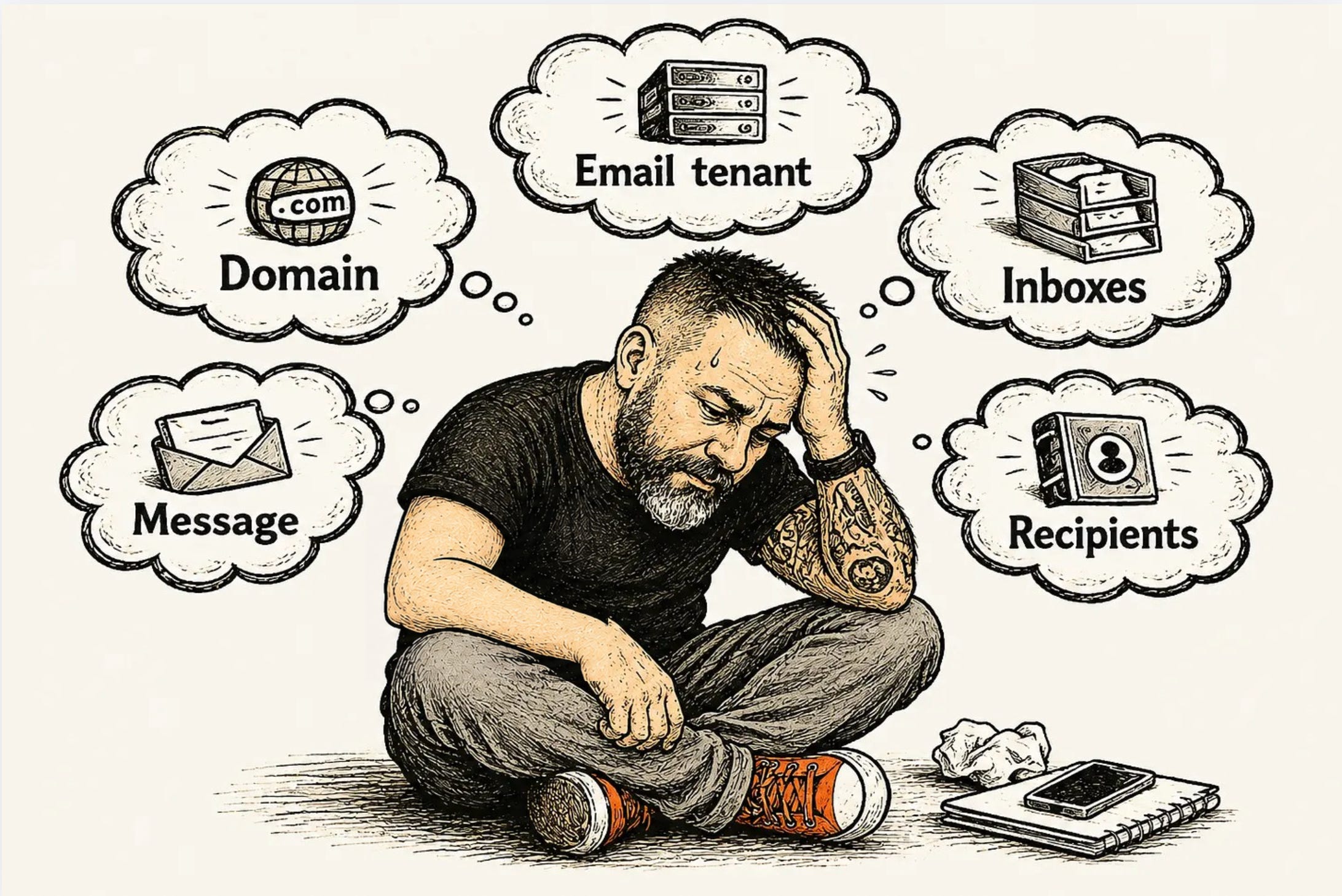
When most people think about email deliverability, they think about one thing: their inbox. But that’s the wrong unit of analysis. Deliverability is a layered system with five distinct levels, and problems can originate at any of them.
Here are the five layers in this trifle:
Layer 1: The domain. Your brand’s domain name exists independently of whether anyone sends email from it. Every domain has a reputation. That reputation is an asset.
Layer 2: The email tenant. When you spin up inboxes for your sales team to send outreach from, you have to choose a housing environment. Your email tenant. Most everybody uses Google’s Workspace or Microsoft’s offerings for their sales teams’ inboxes. Each has different rules, tolerances, and math for how many inboxes you can run per account. This is the tenant level.
Layer 3: Individual inboxes. Each inbox inside a tenant has its own health score. Ten people on your team means ten separate inbox reputations. Every inbox carries its own reputation
Layer 4: The message itself. Plain text versus HTML behaves differently. Sending the same copy repeatedly flags as inauthentic machine behavior. A high volume of messages relative to low engagement destroys reputation at the inbox and domain levels.
Layer 5: The recipient side. Their tenant has policies. Their company may have firewall rules. Individual users have preferences. None of this is under your control.
All these variables can help or hinder your outreach emails from reaching their intended recipients. The point is not to optimize every variable. You cannot. The point is to build a system resilient enough to keep functioning when any individual layer fails or falls short.
Don’t Wreck Your Domain Name
The old approach to cold outbound was simple: use email tied to your company’s main domain. Everybody has one inbox and then sends out a lot of emails to a lot of people they don’t know.
Then the calculus shifted more fundamentally and started to threaten the integrity of a brand’s primary domain.
“Your primary domain is an asset,” said Kellen. “Sending off of it has a non-zero probability of burning it.If you send off your primary domain and it ends up flagged as spam, your customers won’t get their emails from you. That’s existential.”
This is a risk most smaller companies and startups can’t afford to take. Cold outbound to B2B contacts is a significant percentage of any company’s total send volume every day.
Cold outreach emails should not be sent from the same domain or tenant as your normal, everyday one-to-one emails.
Instead of gambling with your brand’s lifeline, you purchase secondary domains specifically for prospecting. For example, if your primary site is company.com, you run your cold outreach from inboxes at getcompany.io or trycompany.com.
By isolating your outbound activity on these “look-alike” domains, you create a firewall for your business. If a secondary domain’s reputation takes a hit due to high volume or spam flags, your primary domain remains unscathed. Your customers continue to receive their invoices, contracts, and support tickets without interruption, and your core brand reputation stays intact.
This is not a workaround. It is becoming the standard infrastructure for any team serious about outbound.
What the Infrastructure Actually Looks Like
If you’re a growth leader who owns the number but not the send infrastructure, this is worth understanding at the architectural level even if you never configure a DNS record yourself. The decision to isolate outbound from your primary domain is a strategic one. The implementation, not so much.
Here is the real setup that serious outbound teams are running.
Domains. You buy multiple domains annually from Cloudflare or GoDaddy. Not your primary. Secondary and tertiary domains that map back to your brand without being your exact brand’s primary domain.
Tenants. You split those domains across Google and Outlook environments. Each tenant has different rules for how many domains per workspace and how many emails each inbox can send per day. A 70/30 split between Google and Outlook is a common allocation.
DNS records. SPF, DKIM, DMARC, and related records need to be configured on every domain. This is commodity work. Vendors can handle it, but it still has to be done.
Inbox warming. You cannot start sending cold from a new inbox immediately. If Google sees a brand new account sending 100 emails a day to strangers, it gets flagged. Warmup means interconnected sending: the warmup network sends messages between inboxes that generate positive sentiment replies. You ramp up slowly over roughly 30 days, then start replacing warmup volume with actual cold email send volume.
Spin-taxing. If Google repeatedly sees the exact same copy sent from the same inbox, that is a machine signal. Spin-taxing rotates synonyms and phrasings throughout the body of each email so no two sends are identical. “Hi / Hello / Good morning, [first name]” is a basic example. You apply this logic throughout the entire message.
List validation. Before you send, make sure you validate every email on your list. A bounce from a contact who left the job is a negative score at the inbox and domain level. Clean your list before it touches your infrastructure.
Placement testing. Many services allow you to send test emails to their addresses to confirm actual inbox delivery. Monitoring tells you if your campaigns are performing. Placement testing tells you if you are actually landing in the inbox at all.
The 200% rule. Carry twice your required send capacity at all times. Run your sends from the A set of inboxes. When something in A flags as an issue, swap in the B set. Buy a replacement B set. Retire the A set. You maintain continuity without interruption. The cost of carrying redundant infrastructure is lower than the cost of being stalled out while you rebuild.
Gotta shoutout to the growth leaders reviewing budgets with the CFO breathing down your neck: this is the same logic as disaster recovery for your production systems - you’re not paying for two sets of inboxes - you’re paying for continuous pipeline coverage.
Mathing the Math to Your CMO
Most sales and marketing teams have not put these methods in place. Some haven’t even heard of it. If you are the person who wants to make it rain, you’ll probably have to make the case internally.
There are two angles. Use both.
The first is defensive. If you are still running cold outbound off your primary domain, you are one bad week of spam complaints away from a company-level crisis. That is not a hypothetical. It happens. Your customers stop receiving emails from you. Contracts, support threads, invoices… all gone to spam. The fix takes months. The damage to a sender’s reputation can be permanent.
The second is offensive. The math of outbound has fundamentally changed.
The old model: 10 SDRs, each reaching 100 contacts per day, equals 1,000 touches. The constraint is headcount. The constraint is the budget for salaries.
The new model: one operator running a properly built send infrastructure can reach 100,000 contacts per day if the TAM supports it. The constraint is the system’s quality.
Kellen puts it this way: “For every team of 10, 20% of that team got 80% of the results. But they were also only allocated about 20% of the market. Now those 20% can control the system that reaches out to 100% of the market.”
The bottleneck was never talent. It was capacity.
The Three-Tier System
This infrastructure does not replace your existing sales motion. It fits alongside it.
Tier 1 is your legacy outbound. Your reps on ZoomInfo or Apollo, working signal-scored accounts, doing direct outreach from their own inboxes against the top 10% of the TAM. This still works. It should still happen.
Tier 2 is the large middle of your TAM that does not flag for a strong signal but should not be ignored permanently. These are contacts your reps would never get to, not because they are bad prospects but because there are too many of them. This is where the infrastructure lives. You run scaled tests, measure what works, and amplify the variants that generate a response.
Tier 3 is everyone you should not be contacting. You eliminate them from the system entirely.
The infrastructure is the middleware for Tier 2. At best, it becomes a primary driver of pipeline. At worst, it surfaces what does not work so you can eliminate it from consideration. Either outcome has value.
This Has Nothing to Do With Newsletters
Cold outbound infrastructure has nothing to do with newsletter deliverability. These are separate systems with separate logic.
Your newsletter probably runs through a dedicated platform like Mailchimp, or through your marketing automation system like HubSpot, off your primary domain, to people who asked to hear from you. Deliverability there is about list hygiene, send cadence, and engagement rates with a known audience.
Your cold outbound runs from secondary disposable domains through a send infrastructure to people who have never heard of you. The entire point is that these domains are expendable. Redundancy is the design principle, not an afterthought.
Running cold outbound through HubSpot off your primary domain is not a deliverability strategy. It is a way to eventually break your newsletter, too.
The Future is Specialization
When Kellen started his agency three years ago, this was genuinely fringe. The rest of the market had no idea it existed.
That has changed. Apollo has built multi-inbox sending into their product. Instantly and Smartlead have scoring built right in. This style of infrastructure is becoming more accessible and more standard every quarter.
But the deeper shift is not about the tools. It is about specialization.
Right now, the standard SDR does everything: calls, emails, LinkedIn, sequences. The emerging model disaggregates those functions. Being a great cold caller is definitely a temperament, a specific personality type. Your best phone rep should only be making calls. Your best email operator can run outbound for 10 companies simultaneously.
AI accelerates this. The operators who can embed their judgment into a system and run it at scale will cover more of the market than a team of generalists working inboxes manually. The 20% who were always the best will now have leverage proportional to the size of the market, not the number of hours in a day.
So why don’t bigger companies do this? Larger brands have the money to just throw more people at the process instead of implementing processes and personnel that specialize and amplify. But as sales and marketing budgets get slashed, bigger firms may start to bring these strategies to their own organizations to get more results with existing staff and spend.
Where to Go From Here
If you want to get into the mechanics of how teams are building these systems, Kellen runs GTM Cafe (gtmcafe.com), the largest independent go-to-market operator community. It is free and he runs weekly calls.
The tools to evaluate your current deliverability situation: Gmass, MailReach, and MXToolbopx for placement testing and DNS inspection, Instantly and Smartlead for inbox scoring if you are already sending from those platforms. If your score is below 98, you have a problem.
If nothing else, start by testing your primary domain. If the answer is bad, you’ve got some work to do. Luckily, this guide told you what to do next.